
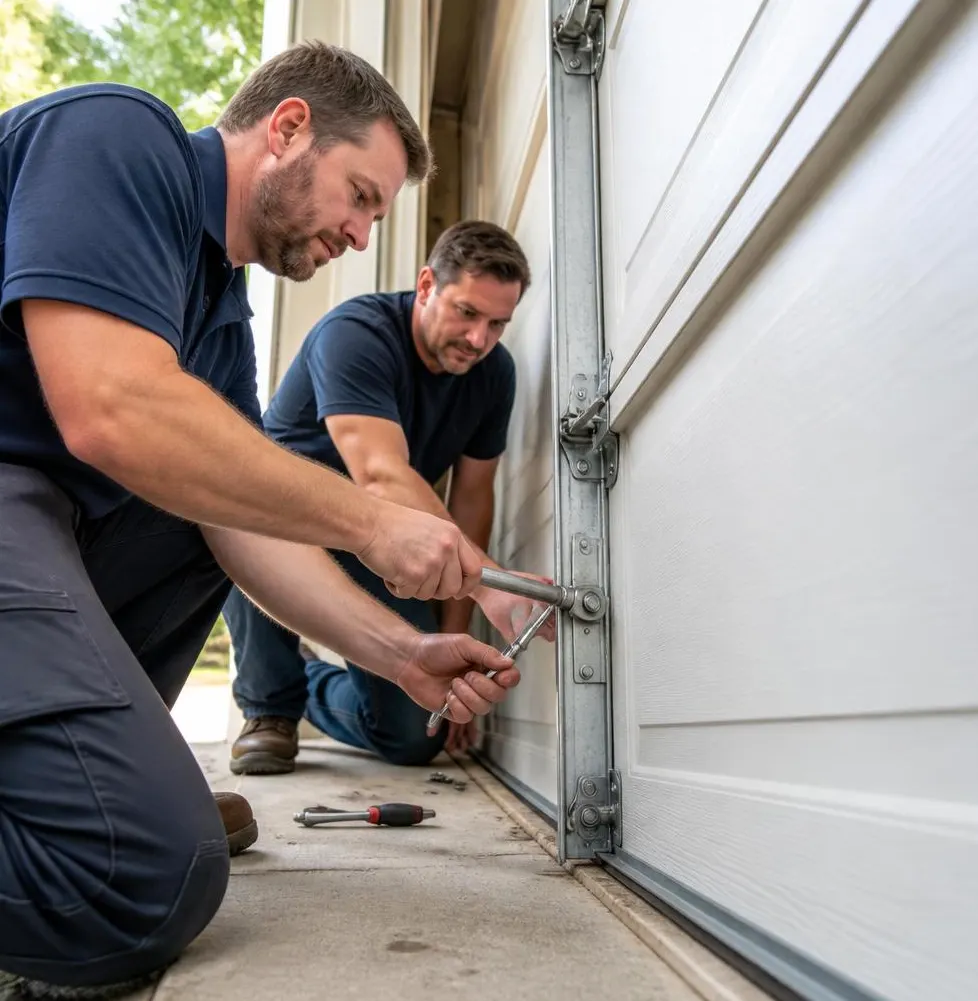
What a Technician Sees on a Call Like This
A typical call during storm season starts the same way: the forecast turns ugly, a homeowner walks out to the garage, and notices the door bowing inward with every gust. Sometimes there's a pair of old 2x4s braced across the inside panels from a storm years back, resting against rollers that are already worn smooth and rusted at the pins. The door opens and closes fine on a calm afternoon, which is exactly why nobody thought twice about it until the wind started picking up. By the time a technician gets there, the real problem usually isn't the door itself — it's everything holding it in the opening: tracks pulling away from the frame, a bottom bracket that's rusted thin from salt air, or an opener with no manual lock engaged.
Why the Garage Door Is the Weakest Wall in the House
A garage door is the largest moving opening in most homes, and it's built to roll up and down rather than stand rigid like a wall. When high wind hits a house, pressure builds on the windward side and drops on the leeward side. If the garage door fails — buckles, blows in, or pulls off its tracks — wind rushes into the garage and pushes up against the roof and walls from the inside. That internal pressure is what causes roof decking to peel back or walls to separate at the corners during tropical storms and hurricanes. This is why wind-load rules exist for garage doors in coastal Florida: the door has to resist both the push of wind coming at it and the pull of wind trying to suck it outward.
Older doors, especially ones installed before current wind-load standards, often don't have the reinforced struts, heavier gauge tracks, or reinforced end brackets that newer doors carry. A door that looks fine in a showroom photo from fifteen years ago may not be rated for what the Lower Keys actually get.
Warning Signs Your Door Won't Hold Up
- Visible flex or bowing in the panels when the door is closed and wind hits it, even on a breezy day.
- Rust at the hinges, track bolts, or bottom brackets — salt air near the coast accelerates this, and a rusted bracket can shear off under load that a solid one would handle fine.
- Tracks that have pulled slightly away from the frame, which you can sometimes see as a gap or hear as a rattle when the door moves.
- Rollers that are cracked, flat-spotted, or missing their bearings, making the door bind or drag instead of running smoothly in the track.
- A door that doesn't fully seat against the weatherstripping, letting in water and wind-driven rain during afternoon downpours, which also points to a track or spring balance problem.
- An opener with no manual locking bar engaged, relying on the opener's motor alone to hold the door shut — motors are not designed to resist storm-force wind pressure.
Getting the Door Ready Before the Next System Rolls Through
- Inspect and tighten all hardware. Track bolts, hinge screws, and roller brackets loosen over time from regular use and from the swelling and contracting that humidity causes in wood-framed openings. A loose bracket under wind load is a failure point.
- Lubricate moving parts — rollers, hinges, and the torsion spring — with a garage-door-specific lubricant rather than general household oil, which attracts grit and breaks down faster in humid, salty air.
- Check for rust early, especially on homes closer to the water. A bracket or track section that's rusted through needs replacing before storm season, not after a door fails mid-storm.
- Engage the manual lock on the opener track before a storm, and consider a battery backup for the opener so the door can still be operated manually if power goes out, which is common during and after tropical systems.
- Know your door's wind rating. If you don't know whether your door or its bracing meets current wind-load expectations for this area, that's worth confirming before hurricane season peaks rather than during an active watch.
- Clear the track of debris after afternoon downpours and windy days — sand, salt residue, and organic debris from storms can work into the track and cause the door to bind right when you need it to seal tightly.
A Note on Bracing
Temporary bracing kits exist for doors that aren't rated for wind pressure, and they can help in a pinch, but they're not a substitute for a door and track system actually built to handle wind load. Bracing that isn't installed correctly — uneven pressure points, wrong anchor points into the frame — can do more harm than good by concentrating stress on one section of the door.
When to Call Summerland Key Overhead Door Co
If you've noticed flex in the panels, rust on the brackets or tracks, a door that doesn't seal tight, or you're just not sure whether your current setup can handle another storm season, that's the point to call rather than wait. We handle off track door repair and cable & roller replacement regularly for homes throughout the Lower Keys where salt air and humidity wear down hardware faster than inland homes see. We'll check the tracks, brackets, springs, and opener, tighten or replace what's compromised, and tell you plainly whether your door's hardware is sound for wind or whether it's time to talk about a garage door replacement with proper wind-load components.
If your garage door has you worried every time the forecast turns, give Summerland Key Overhead Door Co a call. We serve Summerland Key, Big Pine Key, Cudjoe Key, Sugarloaf Key, Ramrod Key, Little Torch Key, Key West, and Stock Island, and we show up when we say we will.