
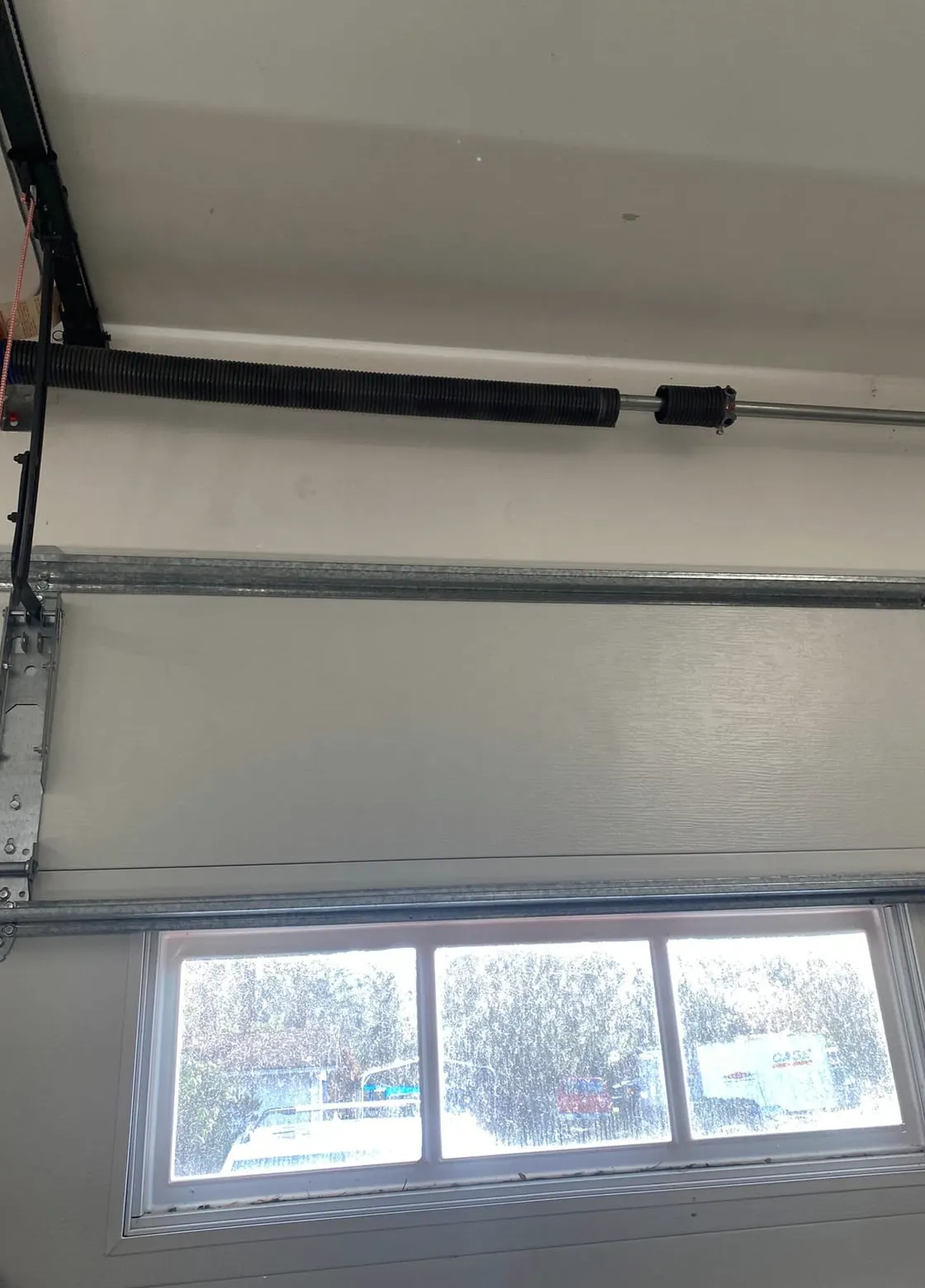
You hit the opener button and the door doesn't lift the way it used to. Maybe it jerks on one side, maybe it hesitates for a second before the motor catches up, maybe there's a metallic pop you've never heard before. You stand there in the garage for a second, waiting to see if it happens again. It does.
That moment is worth paying attention to. Garage door springs rarely fail without warning. They telegraph their wear for weeks, sometimes months, before they actually let go. The trouble is most homeowners don't know what to look for, so the signs get written off as "the door being old" until the spring snaps with a bang loud enough to bring the neighbors out.
Why Springs Wear Faster Out Here
A torsion or extension spring is a piece of steel under constant tension, and tension plus moisture is not a friendly combination. Salt air off the water speeds up surface corrosion, even on springs that look fine from a few feet away. Humidity swings between afternoon downpours and hot, dry stretches cause metal to expand and contract slightly over and over, which stresses the coils faster than it would in a drier climate. And if your door took on extra wind load during hurricane season, the springs may have absorbed more cycles and more strain than a typical year would put on them. None of that means your springs are doomed, but it does mean a visual check a couple of times a year is worth the five minutes it takes.
The Walk-Around Checklist
Do this with the door closed, the opener disconnected or the door manually locked in place, and the garage light on. You're not touching the springs, just looking.
- Gaps between the coils. On a torsion spring (the one mounted horizontally above the door, usually one or two of them on a shaft), the coils should sit close together with even spacing throughout. If you see one section where the coils are spread wider apart than the rest, that's a stretched or weakened section and a sign the spring is losing its ability to hold tension evenly. An uneven spring doesn't just break eventually, it can throw the door off balance long before that happens.
- Rust, flaking, or pitting on the coil surface. Light surface rust on an older spring isn't automatically an emergency, but pitting (small craters in the metal) weakens the steel at that exact point, and that's usually where a spring snaps first. Flaking paint or a rough, scaly texture is often the first visible sign that salt air has been working on the metal longer than you realized.
- A stretched-out look on extension springs. If your door uses extension springs instead of torsion (they run along the horizontal tracks above the door, not on a shaft), check their resting length. A spring that looks noticeably longer or looser than its pair on the other side has lost tension and is doing less of the work, which means the other spring and the opener are compensating.
- Safety cables that look slack or disconnected. Extension springs should always have a cable running through the coil. If that cable is loose, frayed, or hanging rather than taut, it won't do its job of containing the spring if it fails, and that's a safety issue on its own, separate from the spring itself.
- A loud bang, pop, or grinding sound during operation. A sudden bang usually means a spring has already partially failed or shifted on its shaft. Grinding or scraping metal-on-metal sounds often point to a spring rubbing against a bent shaft or worn bearing, which accelerates wear on everything around it.
- The door moving unevenly, tilting, or dropping faster on one side. Springs are matched in pairs so the door rises and falls level. When one spring is weaker than the other, you'll often see the door cock slightly to one side as it opens or closes, or drop unevenly when you release it manually. This is one of the clearest signs that one spring is carrying more load than it should.
- The opener straining, clicking, or reversing mid-cycle. Openers are built to lift a door that's properly balanced by its springs, not to do the springs' job for them. If the motor sounds like it's working harder than it used to, hesitates, clicks, or reverses the door partway through a cycle, the springs are likely losing tension and the opener is picking up the slack. This also shortens the opener's lifespan, so a spring problem can quietly turn into an opener problem if it sits too long.
- Age and cycle count. Most residential springs are rated for a number of open-close cycles rather than a calendar age, but as a rough guide, many springs in regular daily use start showing wear in the range of seven to nine years. If you don't know how old your springs are and the door has been in the house a while, treat the other items on this list as your real evidence rather than guessing by age alone.
What Happens If You Let These Signs Ride
A spring that's wearing out doesn't fail gracefully. It fails while someone is standing under the door, or it lets the door drop hard enough to bend track, crack a panel, or damage the opener's drive gear. Waiting also tends to turn a one-spring repair into a two-spring repair, since the surviving spring has usually been overworked by the time its partner gives out.
When to Call Summerland Key Overhead Door Co
If you've spotted uneven coil gaps, visible rust pitting, a door that's tilting on one side, or an opener that sounds like it's fighting the door, it's time to get it looked at rather than waiting for the loud bang. We handle garage door spring repair for torsion and extension systems throughout the Lower Keys, and if the inspection turns up a worn roller, fraying cable, or a shaft that's seen too much salt air, we'll flag that too as part of a garage door maintenance and tune-up rather than send you home with half the problem fixed.
If your springs are showing their age, don't wait for them to make the decision for you. Call Summerland Key Overhead Door Co for a spring inspection or repair anywhere from Summerland Key to Key West, and get it handled before it turns into an afternoon with a door stuck halfway open.